|
There is no doubt in the fact that the SysInspire nsf to pst converter is one of the most reliable, influential and trustworthy applications available in present time to switch the mailboxes from Lotus Notes NSF file to Outlook.
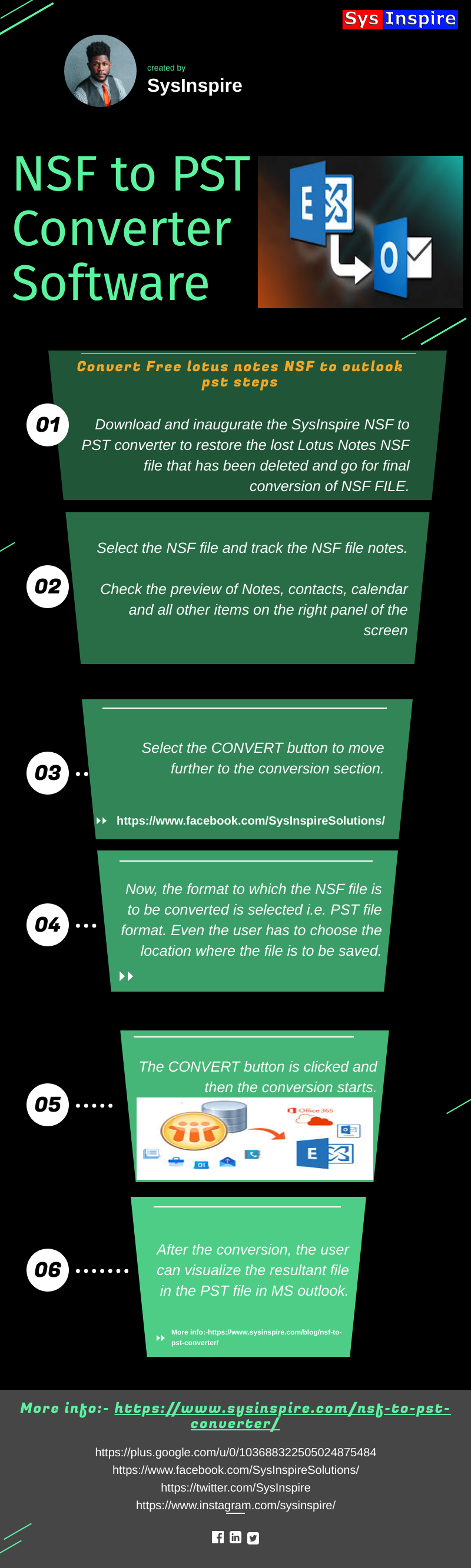
No changes will be found in the original database of Lotus Notes emails even after switching from Lotus notes to outlook. SysInspire Notes to Outlook Converter software is capable of switching all the items that are stored in the NSF file. One can switch emails, contacts, calendars, tasks, notes, journals etc. from Lotus Notes to Outlook email client without facing any problem. The prime advantage of the lotus Notes export software is that it is capable of switching Lotus Notes to Outlook in batch mode. Follow these steps to learn the whole conversion process: Step 1: Launch the SysInspire Notes to Outlook Converter and load NSF Files. Step 2: Setup Saving Options for the confirmation of Resultant PST Files. Step 3: Click on the Export button to Process to the Next Step. Step 4: Apply Filters Settings and other Advanced Options in its Panel. Step 5: Click on Next and observe the entire switching Processes. More info:- Notes to Outlook Converter ![]() |
|
Converting NSF (Notes Storage Facility) files from IBM Lotus Notes to PST (Personal Storage Table) format used by Microsoft Outlook can be a complex process, especially when done manually. This method involves using an intermediary application called the "Microsoft Transporter Suite" to perform the conversion. Please note that manual conversion methods can be technical and may not preserve all data and formatting perfectly. Here's a general overview of the manual process:
Step 1: Prepare Your Environment Install Microsoft Transporter Suite: Download and install the Microsoft Transporter Suite from the Microsoft website. Install Outlook: Make sure Microsoft Outlook is installed on your computer. Step 2: Export NSF Data Create a CSV File: Create a CSV file that contains a list of the mailboxes you want to migrate and their corresponding user names and passwords. Use CSVDE: Use the CSVDE command-line tool to import the CSV file into Active Directory. This step is required for the Transporter Suite to work. Step 3: Use Microsoft Transporter Suite Launch Transporter Suite: Open the Microsoft Transporter Suite application. Create a Migration Project: Create a new migration project and specify the source (Lotus Notes) and target (Exchange) settings. Configure the Migration: Provide the source server information, select the users from the CSV file, and configure migration options. Start the Migration: Begin the migration process. Transporter Suite will create corresponding mailboxes in Exchange and migrate data. Step 4: Export from Exchange to PST Export to PST: In Outlook, use the "Import and Export" feature to export the migrated Exchange mailboxes to PST format. Please keep in mind that this manual process can be challenging, and there are limitations to what can be achieved. Some data and formatting might not transfer perfectly. Additionally, the Microsoft Transporter Suite might have limitations and compatibility issues, as it's an older tool. It's recommended to consider third-party migration tools that specialize in NSF to PST conversion, as they often offer more advanced features and a smoother migration experience. If your organization has complex data or requirements, you might want to consult IT professionals or experts who are experienced in email migration processes. |
| Free forum by Nabble | Edit this page |